Software Designed for Real Business Workflows
Manage procurement, medical inventory, vendors, finance, assets, maintenance, HR, and management reporting for hospitals, clinics, laboratories, and healthcare facilities in one integrated back-office ERP.
Are healthcare operations becoming more complex?
Behind patient care are procurement, inventory, finance, assets, maintenance, people, and administration processes that must remain accurate and auditable.
Medicines and medical supplies are spread across units, warehouses, and branches.
Batches and near-expiry items are not identified early.
Requests, approvals, RFQs, POs, and receipts still rely on documents or chat.
Medical equipment lacks complete maintenance schedules and history.
Budgets, expenses, vendor bills, and payments are disconnected.
Management combines reports manually across functions.
One ERP for healthcare operations
Procurement & Inventory
Medicines, supplies, equipment, batches, expiry, multi-location inventory, and replenishment.
Finance & Budget
Vendor bills, payments, expenses, budgets, AP/AR, ledger, and financial reporting.
Asset, Maintenance & HR
Medical equipment, work orders, preventive maintenance, employees, attendance, and payroll.
An integrated healthcare workflow
Transparent and controlled purchasing
Transaction Control
- Purchase requests, RFQs, supplier comparison
- Purchase orders, goods receipts, returns
- Connected vendor bills and payments
- Last price and spending by department
Approval Hierarchy
- User / Department → Department Head
- Procurement → Finance → Management
- Rules by value, budget, category, and role
- Complete requester and approver audit trail
Control medicines and medical supplies
Inventory Status
Stock movements, transfers, adjustments, counts, minimum stock, and reorder points.
Batch & Expiry
Batch, lot, manufacturing date, expiry, supplier, receipt, quantity, and location.
Stock Planning
Current stock, average consumption, incoming stock, pending POs, and movement.
Control inventory across every unit
Every transfer stores its source, destination, item, quantity, requester, approval, date, and receiving confirmation.
Assets and medical equipment in one database
Asset Register
- Code, location, department, and supplier
- Purchase date and acquisition cost
- Warranty, condition, and responsible person
- Medical, laboratory, HVAC, generator, IT, vehicle
Maintenance
- Preventive and corrective maintenance
- Complaint, technician, schedule, and downtime
- Spare-part usage and maintenance cost
- Work orders and complete history
Integrated budgets, expenses, and finance
Human Resources on the same platform
Management can review workforce, attendance, overtime, and payroll by department or location.
Connect back-office and patient-service systems
HIS / SIMRS
- Patient services and billing
- Pharmacy transactions
- Clinical operations
ERP Back Office
- Procurement and inventory
- Finance, assets, HR, and maintenance
- Management reporting
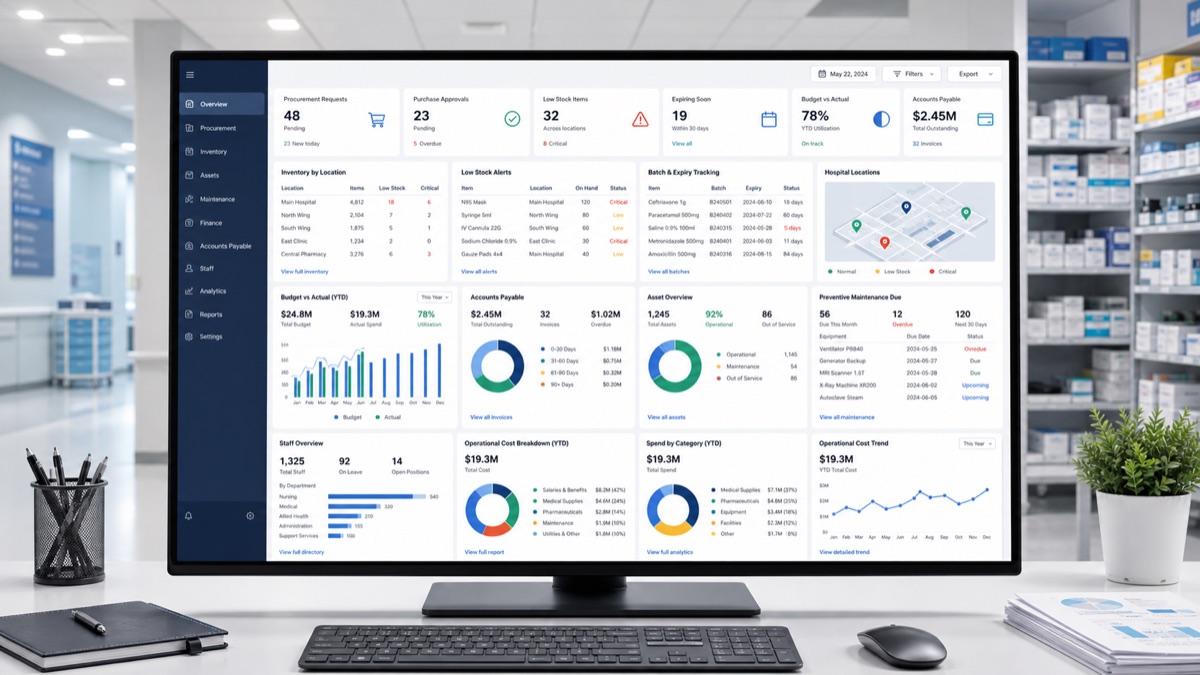
Real-time healthcare operations dashboard
Move from manual work to integrated operations
Before ERP
- Requests, approvals, and POs use separate documents
- Warehouse and finance re-enter transactions
- Engineering keeps separate asset records
- Management manually combines reports
With Healthcare ERP
- Requests and approvals follow the organization
- Receipts update inventory and vendor bills
- Equipment enters the asset register directly
- Finance and management use validated data
Benefits for healthcare organizations
Healthcare ERP modules tailored to your organization
Built for many healthcare organizations
A structured ERP implementation
- 01Business Process Analysis
Analyze procurement, inventory, finance, assets, maintenance, HR, and integration.
- 02ERP Configuration
Configure workflows, approvals, departments, budgets, warehouses, and access.
- 03Data Preparation & Migration
Prepare suppliers, items, inventory, assets, employees, and opening data.
- 04Integration
Integrate HIS, SIMRS, or existing systems through APIs when required.
- 05User Training
Train users according to their functions and responsibilities.
- 06Go Live
Launch ERP for back-office operations.
- 07Support & Optimization
Continuously improve as organizational needs evolve.
Healthcare ERP frequently asked questions
Is Healthcare ERP the same as an HIS or SIMRS?
No. HIS/SIMRS focuses on patient services, while ERP manages procurement, inventory, finance, assets, HR, and management back-office functions.
Can ERP integrate with an HIS or SIMRS?
Yes. Integration is possible through APIs when supported by the connected system.
Can it manage medicine batches and expiry dates?
Yes. Products can be tracked by batch, lot, expiry date, location, and supplier.
Are multi-warehouse and multi-level approvals available?
Yes. Warehouses, locations, and approvals by department, role, value, budget, and transaction are supported.
Can medical equipment and maintenance be managed?
Yes. Equipment records include location, status, warranty, work orders, and maintenance history.
Does ERP support multiple branches?
Yes. It can support multiple locations, branches, and healthcare groups.
Can department access be restricted?
Yes. Roles and permissions can match each user's responsibilities.
Connect procurement, inventory, finance, assets, maintenance, and HR.
Reduce manual work, control costs, protect medical stock availability, and give management faster operational insight.